
On Taylor Swift, Identity and Getting in the Way of Our Own Joy
Or: We need to calm down.

I’ve been thinking a lot about the recent Taylor Swift concert in Munich – how thousands of fans filled the hills around the stadium, so they could listen to the tour without paying for tickets. I can’t get enough of these videos. I scour TikTok to view the show from different angles: in daylight, the people on the hills and the people in the stadium singing along to Cruel Summer; in the dark, their glowing phones and flickering wristbands swaying to Marjorie. I did the same thing with Edinburgh videos, after reading that fans caused a “Swift quake” that registered on a nearby seismometer. I’m looking for something in these videos, a feeling, but not something I can put into words. I just know that every time I watch them I cry a little bit, and I’m embarrassed about it. (Isn’t it very Swift-like to excavate my own shame for public consumption?)
(I rely heavily on parentheticals and questions and parenthetical questions in this post. I’m not sure why. I apologize in advance.)
I don’t go to many concerts. I have a profound aversion to crowds, bordering on a phobia, and when Swifties the world over scrambled for Eras tour tickets, it seemed like none of my business. Sure, I liked her music, even loved some of it, but all the eras? For four hours? Crammed into a stadium with thousands of sweaty teenagers? No thanks. I was perfectly content to scream-sing fuck the patriarchy in the privacy of my own car.
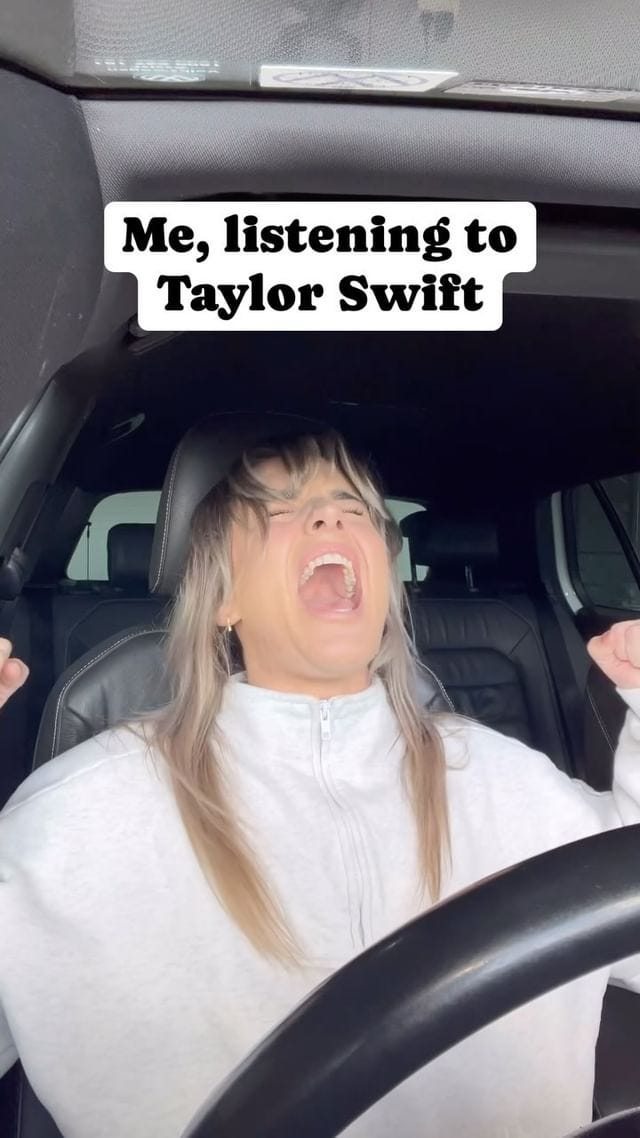
And then, on a whim, I took myself to see the Eras tour film at the movie theater. When I heard Swift’s voice singing It’s been a long time coming, and the crowd on screen started to cheer, I got full-body chills and my eyes watered. I immediately regretted going to see it alone. All around me groups of friends stood up, danced, sang along. I was too ashamed to join them, so I sat in my chair and ate popcorn and all my emotions just sort of rose up and out of me. But quietly. What I’m saying is I cried through the entire concert film.
I wasn’t sad.
(I was sad, but not because of the concert.)
For as long as I can remember, I’ve only been able to access my feelings sideways. I rarely cry from real life, or at least, I rarely cry when it would be expected or appropriate to do so. But I cry very easily from art – music, poems, movies, TV shows, a particularly emotional television commercial. It’s like I store all the feelings up, not intentionally, and then they come out when I least expect it.
A few days ago, my friend Karen sent me a Marginalian article about the neurophysiology of music. It includes a quote from the psychologist Dacher Keltner about this exact phenomenon, which made feel a little bit less like an emotional weirdo:
“Sound waves are transformed into a pattern of neurochemical activation that moves from the auditory cortex to the anterior insular cortex, which directly influences and receives input from your heart, lungs, vagus nerve, sexual organs, and gut. It is in this moment of musical-meaning making in the brain that we do indeed listen to music with our bodies, and where musical feeling begins.”
What I felt, when I saw Taylor on screen, might have been awe.
It’s embarrassing to admit this, but I’m airing embarrassing feelings tonight on Substack, because I think that might be the secret to Taylor Swift’s power, and maybe even the secret to my own, if I can harness it.
My friend Forrest has much more refined taste in music than I do, and is himself a talented musician. He recently agreed to listen to a Swiftie Starter Pack playlist I made for him. Afterwards, we texted about her strengths as a songwriter and performer, and agreed she might be one of those artists, like Springsteen, you had to see live to really “get it.” He mentioned spotting Swifties on the highway last year, driving to her concert in Philadelphia with their cars decorated for the occasion.
“I find those displays a little embarrassing,” I admitted. I realized as I typed it that I was trying to create a distinction between myself, a normal, passive fan, and the kinds of people whose content I consumed. I was the kind of fan who sat politely at the Eras tour movie, keeping my tears to myself, my singalong inside my own head. And on some level I believed this was the only way I was allowed to experience my awe: quietly, privately, like it was something to be ashamed of.
“But why is that?” I wondered to Forrest. “Am I just getting in the way of my own joy?”
(Isn’t that exactly what anxiety does? Wedges itself between us and our joy?)(Why do we let it do that?)
Forrest understood what I meant. It’s absurd to worry what people think of us based on what we like, or don’t like, and yet most of us worry about it anyway. A few years ago, a stranger at a party asked me what kind of music I liked. My mind emptied itself. What was music, even? Had I ever heard a song before? Could I name a single artist I knew, let alone liked? All I could think of at that moment was the Mountain Goats. And I do love the Mountain Goats! But I worried the answer would make me seem like someone who still listened to the music she liked in college. (I am, but that wasn’t what I wanted to convey.) And, though I think John Darnielle is probably the greatest living American songwriter, I don’t even know the words to all the songs on Tallahassee. Did I lack the conviction to be a good fan even to my favorite artist? Which artist could I name that I loved, but also sounded cool, and current, that was neither too obscure nor too mainstream?
My silence stretched out in front of me until, unable to bear it any longer, my husband interjected. “She loves Taylor Swift,” he said.
It was true, so why did I feel so mortified? Perhaps I thought liking Taylor Swift made me seem uncool. Perhaps I thought it conveyed absolutely nothing about me. It was like saying I shopped at Target, or that I wore deodorant. I didn’t identify as someone who loved her. I thought there were only two ways to define yourself in the context of Taylor Swift: you could either be a superfan who decorated your car to drive to the Eras Tour, or you could insist upon disliking her, which was boring in an entirely different way.
(Often steeped in misogyny, but that’s a whole other thing.)
I think I understand the desire to define oneself in opposition to Swift. Don’t we all grapple with the dueling desires to belong, and still feel like an individual? If we like something everyone else likes, doesn’t that weaken our connection to it, and, by extension, our individuality? It can feel good to reject something the masses seems to accept without question, like capitalism or Marvel movies or the military industrial complex. It can feel good to push back against the homogeneity of today’s media landscape, in which algorithms force-feed us the same handful of Capitalism™-approved artists. (Julio Torres skewers this concept so beautifully in Fantasmas, on HBO, that I can’t believe David Zaslav approved it.)
At the same time, maybe it can feel even better to simply enjoy something because we enjoy it. Transgressive, even.
What might happen if we could get out of the way of our own joy?
I love Jennifer Szalai’s 2013 New Yorker essay Against “Guilty Pleasure,” which set me on a path to eradicate the phrase from my vocabulary. “The guilt signals that you’re most comfortable in the élite precincts of high art,” she writes, “but you’re not so much of a snob that you can’t be at one with the people. So you confess your remorse whenever you deign to watch ‘Scandal,’ implying that the rest of your time is spent reading Proust.”
(I’ve never read Proust, and I’m embarrassed about it.)
(Did you notice how before I admitted that thing about Proust, I made it clear that sometimes I read the New Yorker?)
(Do you ever think about how, on their own, “pride” and “shame” are opposites, but in some contexts they can mean the same thing? To have no pride means the same thing as to have no shame. What’s with that?)
What I’m trying to say is, I’m pretty sure even Taylor Swift doesn’t think Taylor Swift is cool.
She doesn’t need to. She owns it. She owns her success, and her talent, and her power, but she doesn’t need us to think she’s cool. Her lyrics run straight to heart of her own insecurities, her shame, her big messy feelings. She doesn’t have to be the best lyricist in the world, or the best singer, or the best dancer. (I mean, I think she thinks she has to strive to be all those things, but most of us don’t need it from her.) Critics who nit-pick her artistic flaws are missing the point. Her songs allow us to stop worrying about being seen a certain way, and just feel seen.
While I struggled with how to write this post, I saw a snippet of a poem on Instagram. (I’m acknowledging that I saw this poem on Instagram, so you don’t think I am trying to come across as someone more literary than I am, but I do love Diane Wakowski and everyone should read her.)
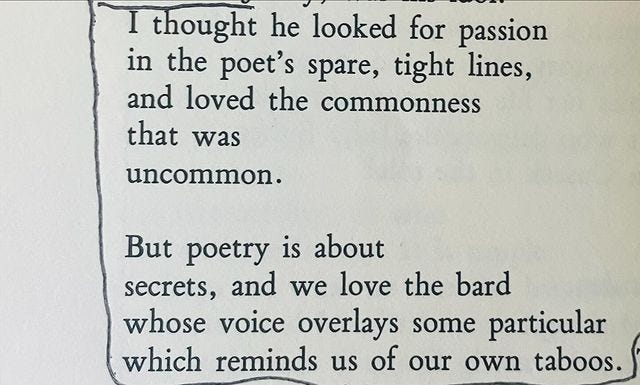
At their best, Swift’s lyrics do exactly this – they overlay “some particular which reminds us of our own taboos.” Her willingness to excavate her own shame (and every other emotion) for public consumption makes her rich, but doesn’t it also enrich her listeners?
(Incidentally, I also think this explains why I love the Mountain Goats so much. And I would pay a lot of money to see Taylor Swift cover No Children. I think she’d really fucking crush it.)
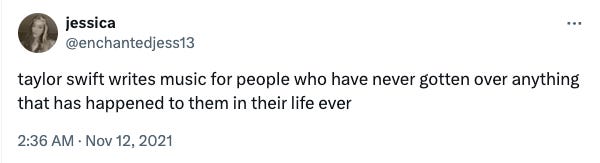
Maybe loving Taylor Swift is actually about rejecting what it might “mean” to love Taylor Swift. Maybe it doesn’t have to mean anything, except perhaps that you’ve never gotten over anything that has happened to you in your life ever. And it turns out there are lots of us.
Even after my experience watching the Eras tour movie in theaters, and again at home when it came to Disney+, I had no plans to see the tour live. The tickets were prohibitively expensive, and what if I had a panic attack? But then, almost completely by chance, I got last-minute tickets to see the tour with two dear friends in Lyon, France. I decided to just go for it, because I was already in France and I wasn’t going to let anxiety get in the way of my joy. And you know what? I didn’t have a panic attack. It was crowded, but I didn’t feel squished, or trapped. I just felt connected to tens of thousands of other people who loved Taylor Swift.
It turns out, it just feels good to love something.
It turns out it feels even better to love something alongside lots of other people.
And it turns out screaming fuck the patriarchy directly into the air above the giant open stadium, alongside tens of thousands of people and Ms. Swift herself is completely different, like on a molecular level, than singing it alone in my car. I wasn’t thinking about what I looked like or sounded like because in that moment I didn’t exist as an individual being in space and time. I didn’t need to look cool or feel cool or have anything to do with the concept of coolness, which suddenly felt very silly to me, very abstract, in the face of all this joy.
When I binge Eras Tour videos on TikTok I’m not just looking to recapture the experience of seeing Taylor Swift in concert, although that’s part of it. I’m searching for that unifying effect, that sense of connection, which only comes when you abandon your need to be seen a certain way. I think I’m talking about vulnerability here. I suspect it’s what people who believe in God feel when they participate in a religious service; I’ve often wondered if belief in a higher power is actually more closely tied to the feeling of experiencing music together, by which I mean, of course, that music is the closest way for an atheist like me to experience the feeling of the divine.
Or, as Keltner puts it in the Marginalian article:
“Music breaks down the boundaries between self and other and can unite us in feelings of awe… We sense that we are part of something larger, a community, a pattern of energy, an idea of the times — or what we might call the sacred.”
This Week’s Delights
Lo Fi, the debut novel from Liz Riggs, which made made me want to smoke a cigarette outside a Wilco concert and text someone I shouldn’t. As I shared on Instagram last week, it’s the perfect book to read if you’re nostalgic for a time you’d never actually want to re-live.
The fact that this playlist exists
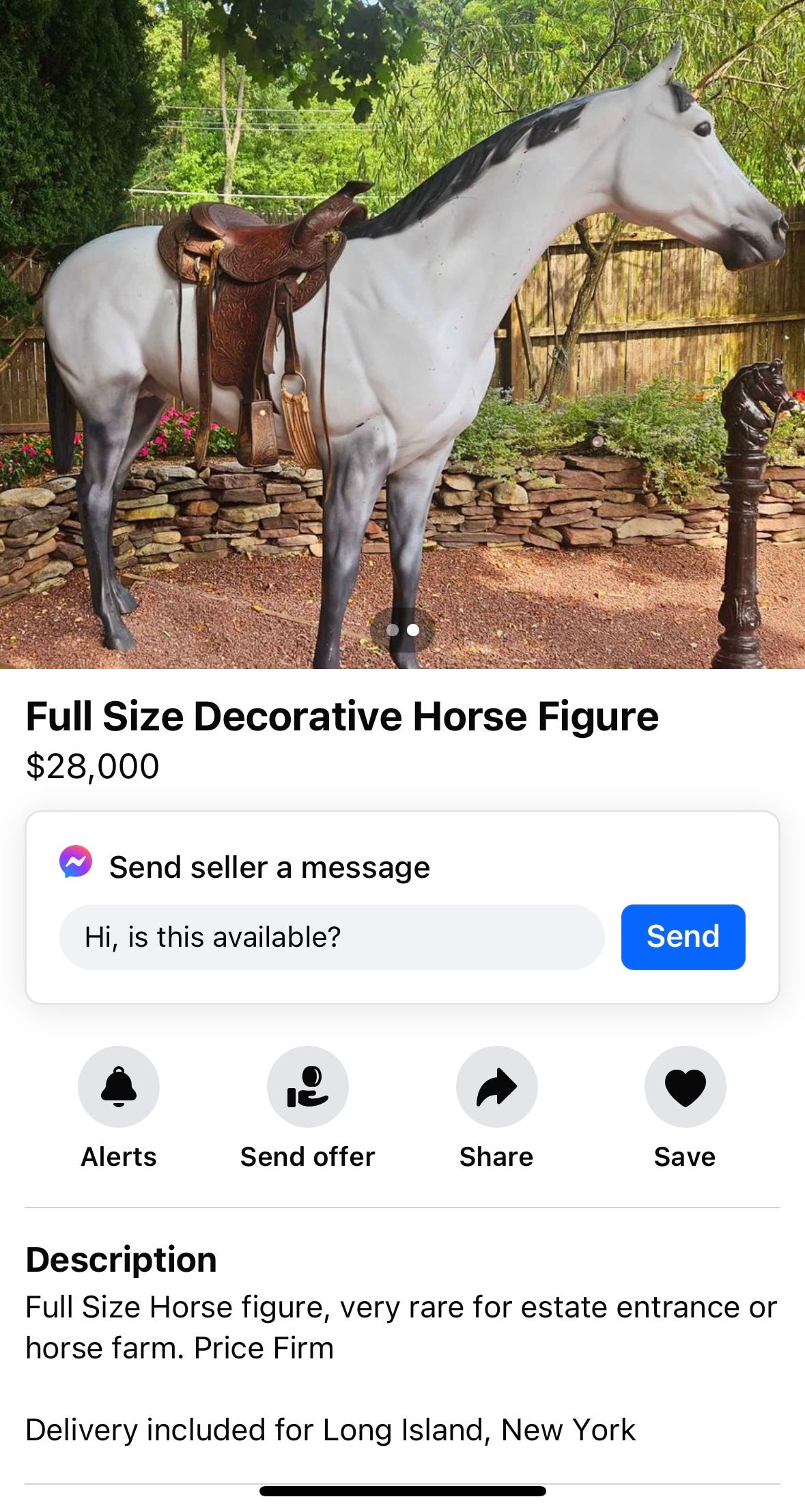
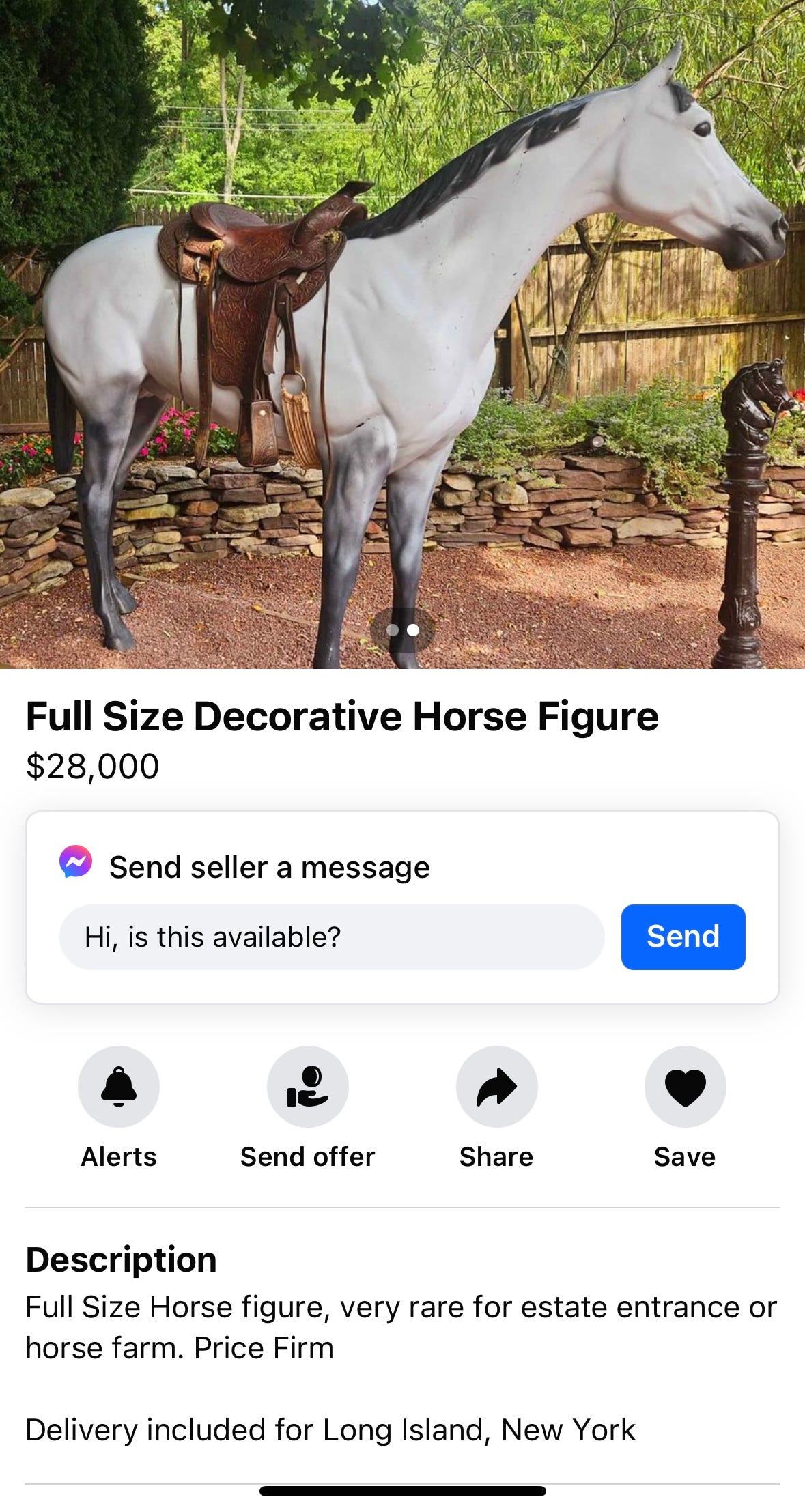
The fact that this full size decorative horse figure exists, in Long Island, for someone with twenty-eight thousand dollars burning a hole in their pocket. (Price firm, but at least there’s free delivery?) Facebook Marketplace is such a gift.
The tweet about Taylor being for folks who've never gotten over anything ever tells me I need to start listening to Taylor. Share that starter pack playlist if you can!
I remember when I first got into TSwift (rather late in the game) and I had never considered myself to have been someone who “loved songs for their lyrics” but, more for the music itself and vocals etc. But there is something within her song lyrics that everyone can relate with. And they are boldly honest! It unleashes a very human reaction in her fans (including me!) 💃